We have seen women interested in HIFU for skin tightening hold back because they are not sure whether it is safe to use at home without professional supervision. This is a reasonable concern. HIFU is a medical-grade technology. But at-home devices operate at significantly lower energy levels than clinical machines, and the evidence base for its safety is substantial. This article answers the safety question completely.
What Makes At-Home HIFU Different From Clinical HIFU
Clinical HIFU devices used in dermatology clinics (the most well-known being Ultherapy) deliver high-intensity focused ultrasound at energy densities and depths specifically calibrated for each individual patient by a trained clinician. Sessions last 30 to 90 minutes. The energy settings allow treatment at depths of 1.5mm to 4.5mm or more with high precision.
At-home HIFU devices operate at lower energy densities designed for safe self-use without professional calibration. They are regulated differently from clinical devices because they are consumer products rather than medical devices operated by licensed practitioners. They use the same focused ultrasound mechanism but at a power level that is appropriate for consistent, repeated home use without the risks that would accompany clinical-level energy in uncalibrated hands.
The result is a device that produces real collagen stimulation effects, confirmed in clinical testing, while having a safety profile appropriate for daily to weekly home use.
What the Clinical Evidence on HIFU Safety Shows
A 2025 systematic review published in PubMed covering 45 clinical trials and cohort studies on HIFU for aesthetic applications found that HIFU demonstrated significant efficacy in skin tightening with improvements in skin laxity ranging from 18 to 30%. Critically for safety: fewer than 5% of patients in the reviewed studies reported adverse events, and those were limited to transient erythema (temporary redness), mild swelling, or mild discomfort. None of the reviewed studies documented permanent injury, scarring, or long-term adverse outcomes from correctly administered HIFU.
A 2025 MDPI safety review of HIFU device application confirmed that the most commonly observed side effect is redness that typically resolves immediately after treatment. The same review confirmed HIFU is generally safe and effective, with most complications being mild and transient when the device is used correctly.
What Can Go Wrong and How to Prevent It
At-home HIFU is safe when used correctly. The documented adverse events from at-home HIFU use are almost entirely technique errors, not device failures.
Surface irritation from insufficient gel
Ultrasound energy requires conductive gel to transmit through the skin. Without sufficient gel, the ultrasound energy partially reflects at the skin surface rather than penetrating to the target depth. Some of this reflected energy stays at the surface and can cause mild discomfort or redness. The MDPI 2025 review confirms that insufficient contact between the device head and skin (which includes insufficient gel) is a primary cause of surface irritation.
Prevention: always apply a generous, complete layer of HIFU Conductive Gel before every session. Never use the device on dry skin.
Over-treating one area
Passing the device too slowly over one area or repeatedly treating the same spot in the same session can concentrate energy above the therapeutic range. The device should be kept in consistent motion throughout each session. Do not pause in one location.
Treating contraindicated areas or conditions
HIFU should not be used over bony prominences (temples, eye sockets), over the thyroid area, over skin with active infection or open wounds, or by women who are pregnant. These contraindications are not about at-home device risk specifically. They are the same contraindications that apply in clinical settings.
Specific Safety Considerations for Pakistani Users
Darker skin tones: Unlike IPL which carries elevated risk for darker skin tones because it targets melanin, HIFU delivers energy based on depth and tissue density, not on melanin concentration. It is safe across all Pakistani skin tones with no increased risk for darker complexions.
Heat and storage: In Pakistan's summer heat, HIFU devices should be stored in cool, air-conditioned environments. Device electronics and the conductive gel can both be affected by extreme heat. Do not leave the device or gel in a car or near a window in summer.
Consistency of use: At-home HIFU is designed for the gradual cumulative collagen response that develops over weeks. Trying to accelerate results by treating more frequently than recommended or at maximum intensity in early sessions does not produce better results and increases surface irritation risk. Follow the recommended protocol of once every 7 to 10 days for the initial course.
The MomDaughts HIFU Anti-Wrinkle Device: Safe Use Protocol
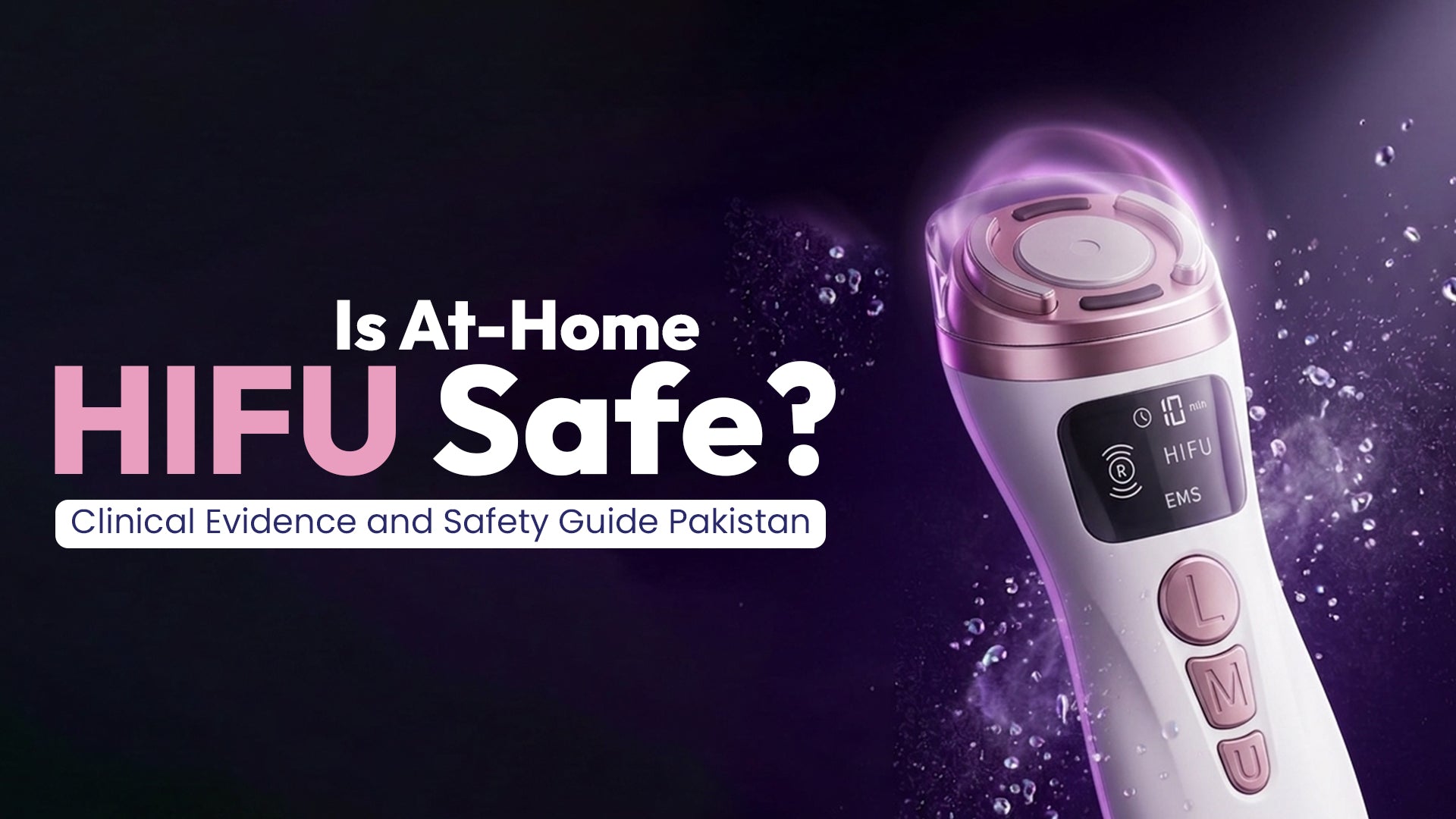
The MomDaughts HIFU Anti-Wrinkle Device is an at-home device designed for skin tightening and wrinkle reduction on the face and neck. Used with the HIFU Conductive Gel, it delivers focused ultrasound energy for collagen stimulation.
Safe use guidelines:
-
Apply conductive gel generously before every session. Never use on dry skin
-
Keep the device moving throughout each session. Do not pause in one location
-
Avoid: eye area, bone-rich areas (temples), thyroid area, active skin conditions, open wounds
-
Start with lower intensity settings and increase gradually over sessions
-
Use once every 7 to 10 days during the initial course, then monthly for maintenance
-
Do not use during pregnancy
When to Stop and Consult a Doctor
Mild redness that resolves within a few hours after a session is normal. Stop using the device and consult a doctor if you experience: persistent redness lasting more than 24 hours, blistering or burn-like changes to the skin, significant swelling that does not resolve within a day, any skin texture changes that were not present before treatment, or any unusual sensation that continues after the session ends.
These outcomes are not expected from at-home HIFU used correctly but warrant medical assessment if they occur.
Frequently Asked Questions
Is at-home HIFU safe?
Yes, when used correctly. A 2025 PubMed systematic review of 45 clinical trials confirmed HIFU as generally safe and effective with fewer than 5% of patients reporting any adverse event, and those limited to temporary redness or mild discomfort. At-home devices operate at lower energy than clinical machines with a safety profile appropriate for home use.
Can at-home HIFU cause burns?
Incorrect use, specifically insufficient conductive gel and treating the same spot repeatedly, can cause surface irritation. Proper technique with conductive gel and consistent device motion prevents this. Burns from correctly administered at-home HIFU are not documented in the clinical literature.
Is HIFU safe for all skin tones including dark Pakistani skin?
Yes. HIFU targets tissue depth, not melanin pigment. It is safe across all skin tones with no increased risk for darker Pakistani complexions.
How many sessions are safe to do?
Once every 7 to 10 days during the initial 4 to 6 session course, then once monthly for maintenance. There is no documented maximum number of lifetime sessions for correctly administered at-home HIFU.
At MomDaughts, we believe safety information should be clear and complete before any purchase. Confidence in every step.