
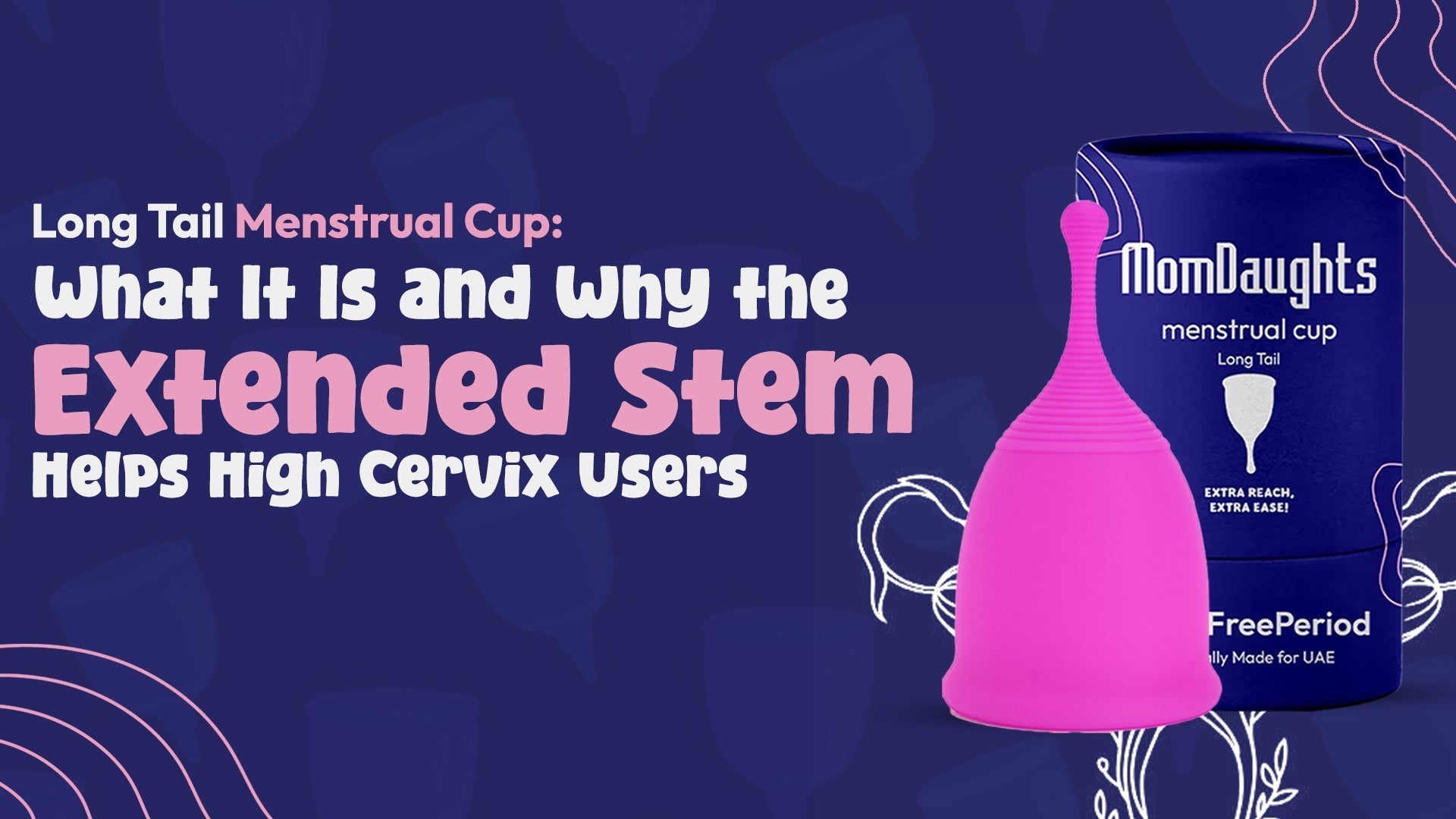
We have seen women with a high cervix try multiple cups, struggle to remove them, and conclude that cups are not for them. Almost always, the problem is not the cup itself but the stem length. Standard cups sit perfectly for women with a medium cervix. For women whose cervix sits higher, a longer stem is what makes the difference between a cup that is easy to remove and one that feels impossible to reach. The Long Tail cup exists for this specific reason.
What the Long Tail Cup Is
The MomDaughts Long Tail Menstrual Cup is a soft, medical-grade silicone menstrual cup with an extended single stem at the base. The longer stem provides a reach point that sits closer to the vaginal opening even when the cup itself is positioned high in the canal, making removal significantly more accessible for women with a medium-to-high cervix.
Like all MomDaughts cups, it is BPA-free, hypoallergenic, and provides up to 12 hours of leakproof protection. It is reusable for up to 10 years and available in Small and Large sizes.
Understanding Cervix Height
The cervix is the lower part of the uterus that projects into the vaginal canal. Its position varies between women. During menstruation, the cervix typically sits slightly lower than at other times in the cycle, but it still varies significantly from person to person.
Women with a high cervix have more distance between the vaginal opening and the cervix. This means that after correct insertion, a standard cup may sit so high that even bearing down fully does not bring the stem within easy reach during removal.
How to check: Insert a clean finger during your period. If you have to reach past the second knuckle, or cannot feel the cervix at all with one finger, you likely have a high cervix. The know your size guide on MomDaughts provides a step-by-step self-assessment.
Why an Extended Stem Makes Removal Easier
During removal, the first step is locating the stem so you can break the suction seal at the base of the cup. With a standard-length stem and a high cervix, the cup sits deep enough that even after bearing down, the stem may be difficult to reach with one finger.
The Long Tail's extended stem hangs lower in the canal, closer to the vaginal opening, reducing the reach required to locate and grip it during removal. Once you locate the stem, you can begin the removal process without the frustrating search that makes cup use feel difficult for high cervix users.
The stem itself is not used to pull the cup out. It serves as a locator and starting point. Once located, you move your fingers up to the base of the cup, pinch to break suction, and guide the cup out from there.
Choosing Your Size
Small. For women who have not given birth vaginally with a light to medium flow.
Large. For women who have given birth vaginally, have a heavier flow, or find the Small fills too quickly. Women with a high cervix and heavy flow benefit particularly from the Large because the cup can be worn longer without needing to be emptied as frequently.
How to Insert the Long Tail Cup
- Wash hands.
- Fold using the C-fold or punchdown fold.
- Insert horizontally, angled toward the tailbone, and release once inside.
- Rotate the base gently to confirm the cup has opened and formed a suction seal.
- The Long Tail stem will hang inside the vaginal canal. Confirm it is fully inside and not protruding. For high cervix users, the stem typically sits well inside the canal with comfortable clearance.
How to Remove the Long Tail Cup
- Wash hands.
- Bear down gently with pelvic muscles, as if going to the bathroom. This lowers the cup toward the vaginal opening.
- Reach for the Long Tail stem. For high cervix users, bearing down should bring the stem within comfortable reach.
- Once you locate the stem, move fingers upward to the base of the cup and pinch firmly to break the suction seal.
- Angle the cup slightly as you guide it down and out to avoid spilling.
- Empty, rinse, and reinsert.
If the stem is still difficult to reach, bear down more firmly, hold for a few seconds, and try again. Do not pull from the stem alone without first breaking suction at the cup base.
Long Tail vs Double Tail vs Short Tail
|
Cup |
Cervix Height |
Key Feature |
|
Short Tail |
Low cervix |
Compact body and stem, fits entirely inside |
|
Double Tail |
Medium-high cervix |
Dual stem for wider, easier grip during removal |
|
Long Tail |
Medium-high cervix |
Single extended stem for maximum reach |
Women with a high cervix can choose between the Double Tail (wider grip, easier to locate) and the Long Tail (longer single stem, maximum reach). The right choice depends on personal preference. Browse all options in the full menstrual cups collection.
At MomDaughts, we believe period care works when the product matches your anatomy. Confidence in every cycle.