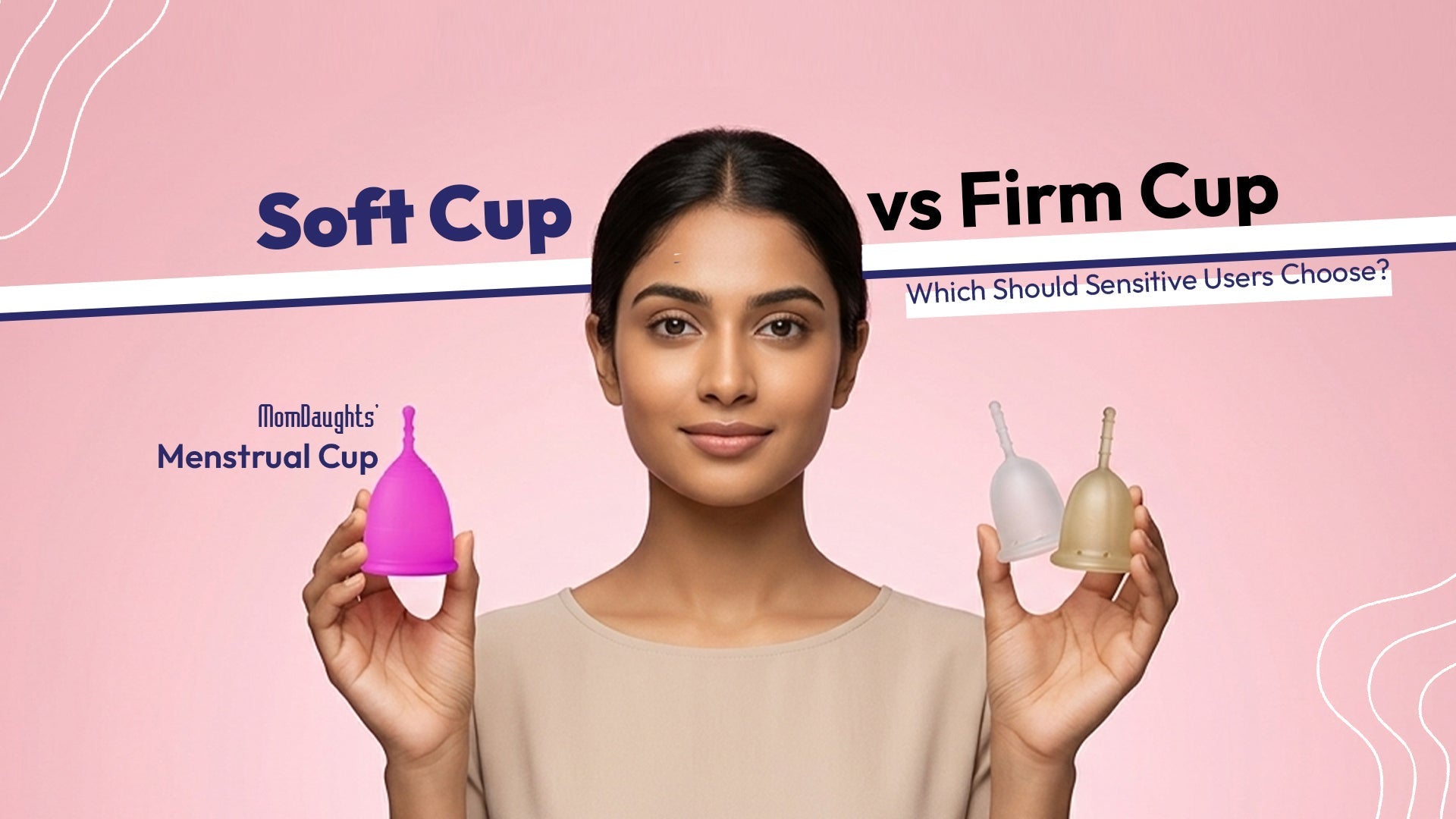
We have seen women switch from one cup to another without understanding what they were changing and why. The firmness of a menstrual cup is one of the most important factors in how comfortable it is to wear, how easily it opens after insertion, and whether it is appropriate for sensitive anatomy. This article explains the practical difference and how to make the right choice.
What Cup Firmness Actually Means
Cup firmness refers to the stiffness of the silicone body and rim. It is determined by the silicone formulation used and the wall thickness of the cup.
A firm cup has significant spring tension in its silicone. When folded and released, it snaps back to its open shape quickly. It maintains its cylindrical form against the vaginal walls with consistent outward pressure. This pressure is what creates the seal and keeps the cup in position.
A soft cup has minimal spring tension. Its silicone is highly pliable, compresses easily, and unfolds slowly when released inside the vaginal canal. It requires more active assistance to open fully but exerts significantly less outward pressure against the vaginal walls and surrounding structures during wear.
Who Needs a Soft Cup
Women with bladder sensitivity
The most common reason women switch from a firm cup to a soft cup. The urethra runs along the front wall of the vaginal canal. A firm cup pressing consistently against this wall can create mild pressure that some women experience as urinary urgency, frequent urge to urinate, or mild discomfort while the cup is in. Soft silicone flexes rather than pressing at a fixed force, which significantly reduces this effect.
Women with pelvic floor tension or conditions
Women who experience any degree of involuntary pelvic floor tightening, including those with vaginismus, hypertonicity, or general pelvic sensitivity, typically find firm cups uncomfortable because the constant outward pressure of the silicone amplifies the tension they already feel. A soft cup is gentler against these muscles during both wear and removal.
Beginners and first-time users
The physical sensation of any internal product is new and unfamiliar for first-time users. A firm cup that presses confidently against the vaginal walls is perceived as more intrusive during the learning phase than a soft cup that flexes with body movement. Many first-time users find soft cups easier to begin with, even if they later transition to a firmer cup for reliability.
Teenagers and younger users
Smaller anatomy responds better to soft, pliable silicone that conforms rather than expands to a fixed shape. For very young or first-time users, the Collapsible Cup's ultra-soft silicone is typically the most comfortable starting point.
Who Needs a Firm Cup
Women who struggle with cup leaking from incomplete seals
A firm cup opens reliably after insertion due to its spring tension. For women who consistently have difficulty getting a soft cup to open fully and form a seal, a firmer cup solves this immediately. If you have been following correct insertion technique with a soft cup and still experiencing leaking, firmness may be the issue rather than technique.
Active women and athletes
During intense physical activity, the pelvic floor contracts with higher force. A soft cup can collapse partially under this increased inward pressure, breaking the seal momentarily. A firm cup maintains its shape against the contracting pelvic floor, providing more reliable leak protection during running, exercise, or sports.
Women with weak pelvic floor tone
Paradoxically, women with very weak pelvic floor tone may find firm cups more reliable because the cup's own spring tension provides structural support that compensates for less pelvic floor engagement.
MomDaughts Cup Firmness Guide
|
Cup |
Firmness |
Best For |
|
Ultra-soft |
Bladder sensitivity, beginners, teenagers, travel |
|
|
Medium |
Low cervix users wanting reliable seal |
|
|
Medium |
High cervix users wanting reliable seal |
|
|
Medium |
Beginners who need reliable opening + easy grip |
The Double Tail and Short Tail cups use medium-firmness silicone that opens reliably while exerting less pressure than the firmest cups on the market. For women who find ultra-soft cups too technically demanding but firm cups too uncomfortable, the medium-firmness variants are the most common resolution.
The Firmness Trade-Off: A Practical Summary
|
Property |
Soft Cup |
Firm Cup |
|
Opening reliability |
Requires deliberate technique |
Opens reliably with minimal assistance |
|
Comfort during wear |
Gentle, low pressure |
More consistent pressure against walls |
|
Bladder comfort |
Better for sensitive bladders |
May cause bladder pressure in some users |
|
Leak protection during activity |
Lower (can collapse) |
Higher (maintains shape) |
|
Learning curve |
Moderate (opening technique) |
Lower (opens itself) |
|
Best for |
Sensitive anatomy, beginners |
Active use, reliable seal priority |
Testing Firmness Before Committing
If you are unsure which firmness suits your anatomy, a simple self-assessment helps. Do you experience any of the following with your current or previous cup?
-
Frequent urge to urinate while the cup is in
-
Awareness of the cup during normal sitting or walking
-
Pelvic pressure that does not match your flow
-
Discomfort that resolves immediately when the cup is removed
These are signals that your current cup may be too firm for your anatomy.
Conversely, if you experience consistent leaking from a soft cup despite correct technique, or if the cup collapses during physical activity, moving to a medium-firmness option will likely resolve both issues. Browse the full menstrual cups collection to compare all variants.
Frequently Asked Questions
How do I know if my cup is too firm for me?
Signs include mild bladder pressure, frequent urge to urinate while the cup is in, awareness of the cup during normal activity, and pelvic discomfort that resolves when the cup is removed. These indicate the cup is exerting more outward pressure than your anatomy is comfortable with.
Can I use a soft cup if I am physically active?
Yes, but you may need to empty it more frequently on active days, and ensure the opening technique is correct. Women who exercise intensely daily often find medium-firmness cups provide more reliable leak protection.
Is there a softer option if the Collapsible Cup feels too firm?
The Collapsible Cup is the softest cup in the MomDaughts range. If it still feels too firm, it is worth consulting a pelvic floor physiotherapist to assess whether a pelvic floor condition is contributing to the sensitivity, as it may require a different type of intervention rather than a different cup firmness.
At MomDaughts, we believe the right cup for your body is the one you do not feel. Confidence in every cycle.