We have seen women hesitate to use their cup on work trips or extended travel because they are not sure how to manage end-of-cycle sterilization without their usual kitchen setup. The Collapsible Sterilizer Cup was designed specifically to eliminate this barrier. This article covers every practical scenario Pakistani women face when managing cup hygiene away from home.
Why End-of-Cycle Sterilization Matters Even When Traveling
Sterilization at the end of your period is the one hygiene step that cannot be skipped or substituted with washing alone. Soap and water cleaning during the cycle removes surface contamination but does not eliminate the bacteria that have accumulated in the cup's micro-surfaces, suction holes, and stem junction over a full period.
When you travel, your period does not align itself with your return home. Women who travel for work, attend weddings in other cities, go for Hajj or Umrah, or spend extended time with family frequently need to complete their end-of-cycle care away from their own kitchen. Having the right equipment makes this straightforward.
The Collapsible Sterilizer Cup: Why It Works for Travel
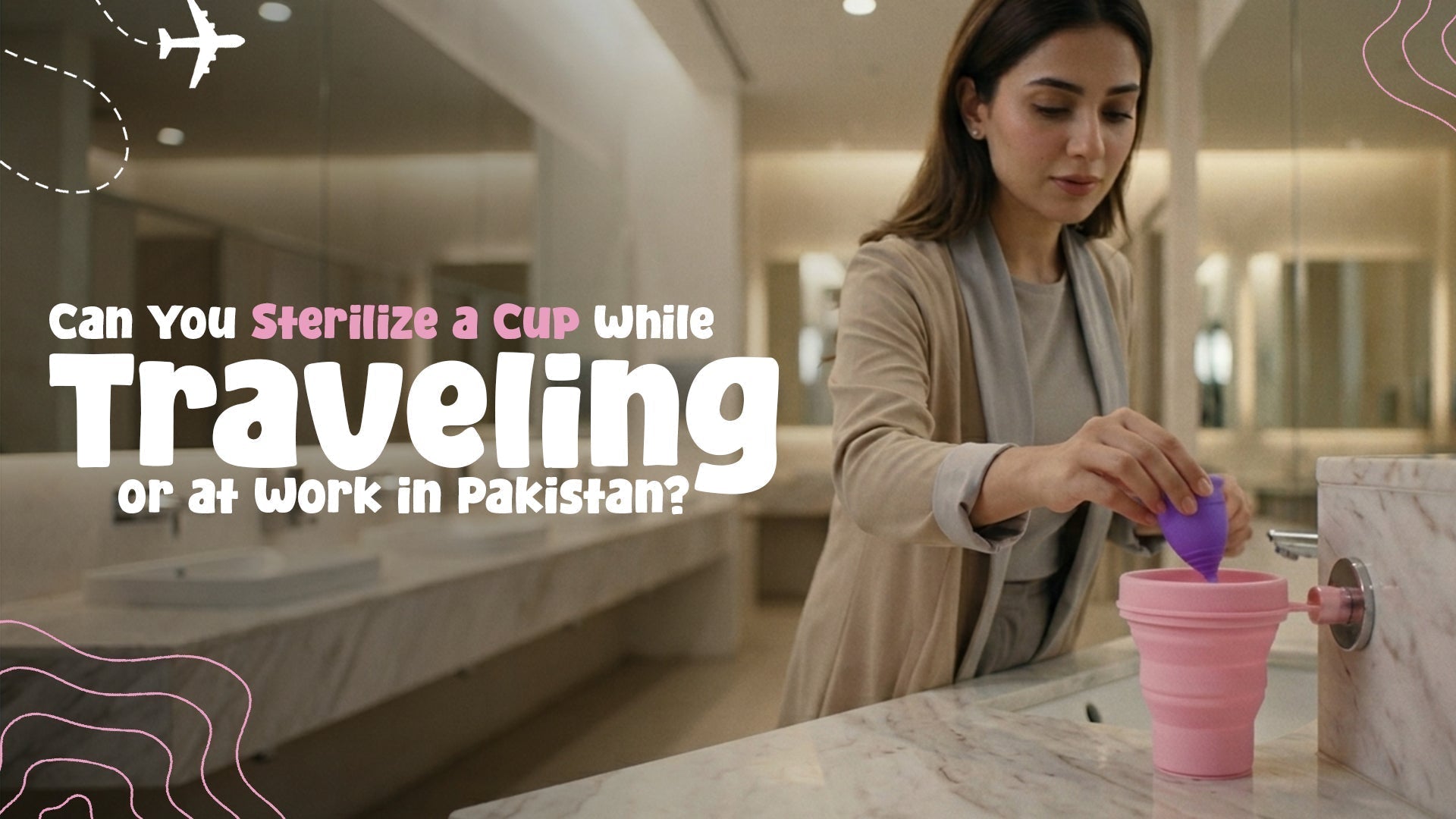
The Collapsible Sterilizer Cup is made from food-grade, microwave-safe silicone that collapses to a flat disc shape when not in use. Unfolded, it holds enough water to fully submerge a menstrual cup for sterilization. It works on any stovetop surface (gas, electric, induction) and in any standard microwave. When collapsed, it adds negligible weight and volume to a travel bag.
For a product that serves a once-per-cycle purpose, collapsing flat for storage is the practical difference between a sterilizer that stays home and one that travels with you.
Sterilizing in a Hotel Room or Hostel
Most hotel rooms and hostels have either a kettle, a microwave in the common kitchen, or access to a stovetop.
Kettle method (if no microwave or stovetop is available): Place your clean cup in the collapsible sterilizer. Boil water in the hotel kettle. Pour the boiling water over the cup until it is fully submerged. Allow to sit for 5 minutes. While this is not the same as sustained boiling, it is a reasonable temporary substitute when no heat source is available. Follow with a full stovetop or microwave boil at the earliest opportunity.
Microwave method (most common in hotels): Place the cup in the unfolded sterilizer, fill with water, put the lid on slightly ajar (never sealed), and microwave on high for 2 to 3 minutes until water reaches a full boil. Remove carefully. Allow to cool before handling. This method is fully effective and takes less than 5 minutes.
Stovetop method (in hostel kitchens or serviced apartment): Follow the standard stovetop method: fill the sterilizer with water, place on heat, bring to a boil, and boil gently for 3 to 5 minutes.
Sterilizing at the Office or University
Pakistani offices and universities increasingly have microwave facilities in staff rooms and common areas. A microwave sterilization takes 2 to 3 minutes and requires only the sterilizer cup, water, and 10 minutes total (including cooling time). The cup itself is completely enclosed in the sterilizer during the process. There is nothing visible or identifiable to colleagues.
The entire process can be done discretely during a lunch break or after working hours. The sterilizer collapses and fits in a standard handbag or tote alongside the cup's breathable storage pouch.
Sterilizing During Hajj or Umrah
Hajj and Umrah accommodations in Makkah and Madinah vary from hotel rooms to shared dormitory-style accommodation. Most hotel rooms have a kettle. Many building blocks in the Haram area have common kitchen facilities with stovetops or microwaves.
For pilgrimage specifically, the microwave method is the most practical. Pack the Collapsible Sterilizer Cup flat in your day bag. When end-of-cycle sterilization is needed, use the nearest accessible microwave. The entire process is complete in under 10 minutes and requires only access to water and a microwave.
If no microwave or stovetop is accessible during the pilgrimage period, the kettle pour-over method provides temporary bridge hygiene until a proper heat source is available.
Sterilizing on Road Trips or Long Bus Journeys
Pakistan's intercity travel frequently involves overnight or multi-day journeys with rest stops. If your period ends during travel, sterilization can be delayed until you reach your destination as long as the cup is clean and dry from its last washing. Store it in the breathable pouch during transit.
Do not store the cup in an airtight container if it is not yet sterilized. The breathable pouch is the correct storage even before end-of-cycle sterilization.
Complete the sterilization at your destination using whatever heat facility is available. There is no time limit on when sterilization must occur after the period ends, as long as the cup is stored correctly (clean, dry, in a breathable container) in the interim.
When You Cannot Sterilize: What to Do
If you are in a situation where no heat source is available and your period has ended, the safest approach is to store the cup in its breathable pouch until you can access boiling water, then sterilize before the next use.
Do not use the cup again without sterilizing after the previous period ended. Even a thorough soap and water washing cannot substitute for the end-of-cycle boil.
Packing for Cup Care on a Trip
For any trip where you may have your period:
-
The cup in its breathable storage pouch
-
The Collapsible Sterilizer Cup (flat, takes almost no space)
-
A small bottle of mild fragrance-free liquid soap
-
A small spray bottle of water (for public bathroom rinsing)
This complete kit fits in a standard pouch smaller than a pencil case and covers every aspect of cup care regardless of where you are.
Frequently Asked Questions
Can I sterilize my menstrual cup in a microwave at work?
Yes. The Collapsible Sterilizer Cup is microwave-safe. Fill with water, place lid slightly ajar, and microwave on high for 2 to 3 minutes until water boils. Allow to cool before handling. The process is discreet and takes under 10 minutes total.
What if I am traveling and have no access to a microwave or stovetop?
Use the kettle pour-over method as a temporary measure: boil water in a kettle, pour over the cup in the sterilizer, and leave for 5 minutes. This provides partial sterilization. Complete a full boil at the earliest opportunity. Store the cup in its breathable pouch in the interim.
Is it safe to delay end-of-cycle sterilization by a few days?
Yes, if the cup is stored clean and dry in its breathable pouch. Sterilize before the next use. Do not insert an un-sterilized cup that was last used at the previous period.
At MomDaughts, we believe practical tools should travel as easily as you do. Confidence in every cycle.