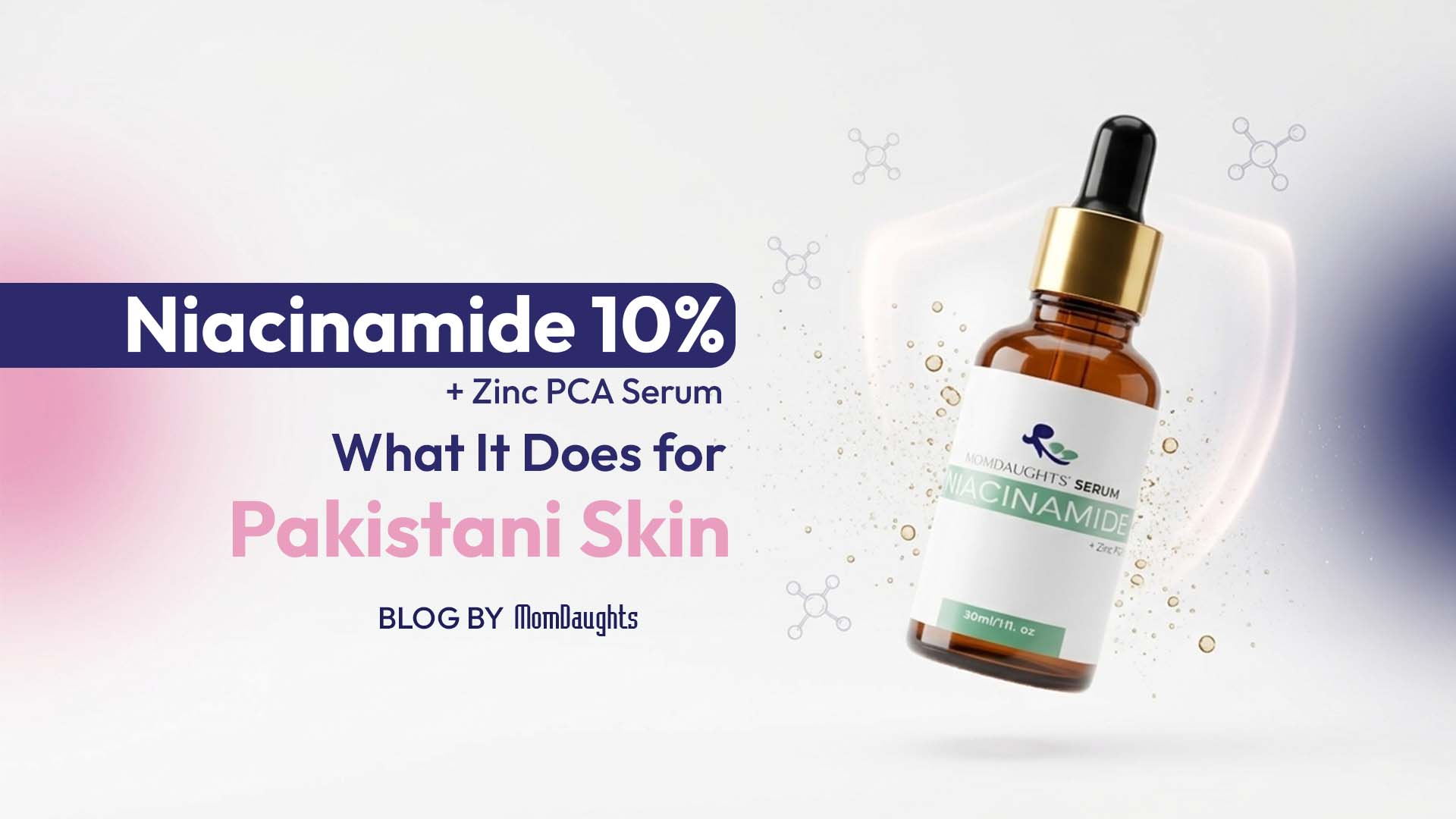
We have seen women use three or four products for different skin concerns without knowing that one well-formulated serum can address most of them at once. This article breaks down exactly what niacinamide and Zinc PCA each do, why the 10% + 1% combination works, and who genuinely needs it.
What Niacinamide Actually Is
Niacinamide is the active form of Vitamin B3. It is water-soluble, meaning it absorbs quickly into skin without leaving residue, and it is one of the most extensively studied ingredients in cosmetic dermatology.
A 2024 review published in PubMed describes niacinamide as recognised for its significant dermal benefits including skin brightening, anti-ageing properties, and protection of the skin barrier. That summary covers three of the most common skin concerns Pakistani women deal with: uneven tone, early signs of ageing, and a weakened barrier that leads to sensitivity and breakouts.
What makes niacinamide particularly useful is that it is effective across all skin types. A 3-week clinical study published in MDPI Applied Sciences confirmed that niacinamide works for dry, combination, oily, and acne-prone skin, as well as both younger and mature skin. It is one of the few active ingredients with this range.
What Niacinamide Does: Each Benefit Explained
Fades Dark Spots and Hyperpigmentation
This is the benefit most Pakistani women seek first, and it is clinically supported. Niacinamide works by inhibiting the transfer of melanosomes, the cells that carry pigment, from melanocytes to the surface of the skin. A study published on PubMed confirmed that niacinamide is an effective skin lightening compound through this exact mechanism.
WebMD reports that skincare products containing 5% niacinamide may help improve the appearance of dark spots. The MomDaughts formulation contains 10%, double that concentration.
Reduces Acne and Breakouts
Niacinamide has been directly compared to prescription-strength acne treatments in clinical trials. According to WebMD, a study in the International Journal of Dermatology found that a topical 4% niacinamide mixture was as effective as 1% clindamycin in treating acne. Clindamycin is an antibiotic commonly prescribed for bacterial skin infections.
Niacinamide also reduces sebum production, a key driver of acne on oily Pakistani skin. A double-blind, placebo-controlled study on sebum control conducted with 100 Japanese subjects found that 2% topical niacinamide significantly reduced sebum excretion rates after just 4 weeks of application.
Minimises Pores and Smooths Texture
A randomised, double-blind, placebo-controlled split-face study documented on PMC found that 4% niacinamide alone reduced pores and skin unevenness after 8 weeks of use, and improved wrinkles after 12 weeks. At the 10% concentration in this formulation, the results are faster and more pronounced.
Strengthens the Skin Barrier
Niacinamide promotes the synthesis of ceramides, fatty acids, and structural proteins in the stratum corneum, the outer protective layer of the skin. When the barrier is intact, skin holds moisture better, reacts less to environmental triggers, and recovers faster from breakouts. This makes niacinamide valuable for women who notice their skin becoming sensitive, reactive, or dry after repeated acne treatments.
What Zinc PCA Does and Why It Is Added
Zinc PCA is not a filler ingredient. It is a compound that combines zinc, a mineral known for its sebum-regulating and antibacterial properties, with PCA, which is pyrrolidone carboxylic acid, a natural moisturising factor already present in healthy skin.
The combination matters because zinc alone has limited skin absorption. When bound to PCA, zinc penetrates deeper into the skin and becomes significantly more bioavailable. An in-vivo test conducted by the ingredient manufacturer showed that 1% Zinc PCA reduces sebum production statistically significantly after 28 days of consistent application.
Zinc PCA Controls Oil at the Source
Most oil-control products work by absorbing excess sebum from the skin surface. Zinc PCA works differently. It inhibits the 5-alpha reductase enzyme, which is responsible for converting testosterone into dihydrotestosterone (DHT), the hormone that triggers excess sebum production. By reducing DHT activity at the cellular level, Zinc PCA addresses the cause of oiliness rather than managing its surface effect.
Zinc PCA Fights Acne-Causing Bacteria
A systematic review published on PubMed confirmed that zinc has antibacterial and anti-inflammatory effects and may decrease sebum production. Zinc PCA specifically targets Propionibacterium acnes, the bacteria responsible for inflamed acne lesions, without disrupting the skin's natural microbiome the way harsh chemical treatments do.
Zinc PCA Hydrates While Controlling Oil
This combination is what makes Zinc PCA particularly useful for Pakistani skin. The PCA component is a natural moisturising factor, meaning it attracts and retains water within skin cells. This is why Zinc PCA controls oil without drying the skin, a common problem with alcohol-based mattifying products that strip the barrier and create a cycle of overproduction.
Why 10% Niacinamide + 1% Zinc PCA Work Better Together
These two ingredients address oily, acne-prone, and uneven skin through different mechanisms, which is why the combination is more effective than either ingredient alone.
|
Concern |
Niacinamide 10% |
Zinc PCA 1% |
|
Excess oiliness |
Reduces sebum production |
Inhibits DHT-triggered sebum at source |
|
Active acne |
Anti-inflammatory, equal to 1% clindamycin in studies |
Antibacterial against P. acnes |
|
Dark spots and hyperpigmentation |
Blocks melanosome transfer |
Supports barrier for faster recovery |
|
Enlarged pores |
Reduces pore visibility after 8 weeks |
Controls oil that stretches pores |
|
Skin barrier |
Promotes ceramide and fatty acid synthesis |
PCA component retains moisture |
|
Sensitivity and redness |
Reduces UV-induced inflammation |
Anti-inflammatory, soothes irritation |
Who Needs This Serum
This formulation is suited to a wide range of skin concerns, but it is particularly relevant for four types of skin common among Pakistani women.
Oily and combination skin. The dual action of niacinamide and Zinc PCA reduces sebum from two separate pathways, resulting in a noticeably less oily complexion within 4 to 6 weeks of consistent use.
Acne-prone skin. If your skin breaks out regularly and leaves dark marks behind, this serum addresses both stages. Active breakouts are reduced through niacinamide's anti-inflammatory and anti-sebum action and Zinc PCA's antibacterial properties. Post-acne marks are lightened through niacinamide's melanin-inhibiting mechanism.
Skin with uneven tone and dark spots. Pakistan's climate involves high UV exposure for most of the year. Sun-induced hyperpigmentation, post-inflammatory marks from old breakouts, and uneven tone across the face and neck are among the most common skin complaints locally. Niacinamide at 10% addresses all three.
Sensitive skin that reacts to stronger actives. Niacinamide is non-irritating compared to most other acne and brightening treatments. It does not cause the peeling, redness, or purging associated with retinol or high-strength acids, which makes it a suitable first active for women who have not used serums before.
How to Use This Serum
Apply the Niacinamide 10% + Zinc PCA serum morning and evening after cleansing and before moisturiser. The formula is lightweight and fast-absorbing, so it does not interfere with other products layered on top.
Do a patch test before your first full application. Some skin experiences a brief purging phase in the first week as the serum encourages skin cell turnover. This typically settles within two weeks and is a sign the ingredient is working, not a sign of a reaction.
Can You Layer It With Other Serums?
Niacinamide pairs well with most active ingredients and can be used at the same time as the Hyaluronic Acid serum for added hydration, or alternated with the Retinol serum for anti-ageing concerns. For acne-prone skin, layering with the Salicylic Acid serum on alternate evenings addresses both surface exfoliation and deeper oil control.
If you are building a serum routine for the first time, the serums collection is organised by skin concern, making it easier to identify which combination suits your specific needs.
When to Expect Results
Realistic expectations based on clinical evidence:
|
Concern |
Expected Timeline |
|
Reduced oiliness and shine |
2 to 4 weeks |
|
Fewer active breakouts |
4 to 6 weeks |
|
Visibly smaller pores |
6 to 8 weeks |
|
Faded dark spots |
8 to 12 weeks |
|
Improved skin texture and tone |
10 to 12 weeks |
Consistency matters more than frequency. Using it twice daily every day for 8 to 12 weeks produces significantly better results than sporadic use at higher frequency.