We have seen women with persistently clogged pores, blackheads, and oily skin try every moisturizer and face wash available without making meaningful progress. The reason is almost always the same: they have not addressed the inside of the pore, only the surface. Salicylic acid is the one ingredient that actually goes inside. This article explains what it is, how it works, and why Pakistani skin responds to it so well.
What Salicylic Acid Is
Salicylic acid is a Beta Hydroxy Acid (BHA), a type of chemical exfoliant derived from willow bark. Unlike Alpha Hydroxy Acids (AHAs) such as glycolic acid, which are water-soluble and work only on the skin's surface, salicylic acid is oil-soluble. This single chemical property is what makes it uniquely effective for acne and oily skin.
Because it dissolves in oil, salicylic acid can penetrate through the sebum that fills and blocks pores, travel inside the follicle, and exfoliate the dead skin cells and debris that accumulate there. Surface exfoliants cannot do this. They remove dead cells from the outer skin but cannot reach what is inside the pore.
How Salicylic Acid Works: Step by Step
When salicylic acid is applied to skin, it performs two simultaneous functions.
Inside the pore. It penetrates through oil into the follicle, where it breaks down the bonds between dead skin cells and softens the plug of sebum and cellular debris that forms a blackhead or whitehead. Over consistent use, this clears existing congestion and prevents new plugs from forming.
On the skin surface. It acts as a mild exfoliant, removing the outer layer of dead skin cells that can trap oil and bacteria at the follicle opening. This reveals smoother, more refined skin texture and reduces the visibility of enlarged pores.
Salicylic acid also has a mild anti-inflammatory effect, which reduces redness around active breakouts and makes acne-prone skin less reactive to the hormonal and environmental triggers that cause new blemishes.
Why It Matters for Pakistani Skin
Pakistani skin in an urban environment deals with heat, humidity, air pollution, and frequent sun exposure year-round. All four factors stimulate excess sebum production and accelerate the rate at which dead skin cells accumulate at follicle openings.
The result is one of the most common skin complaints we hear: persistent blackheads on the nose and chin, large-looking pores, oily T-zone, and recurring breakouts that surface in the same areas cycle after cycle. Salicylic acid addresses this pattern directly by working inside the structure where it starts.
It is also well-tolerated by darker skin tones. Unlike stronger exfoliants such as glycolic acid at high concentrations, salicylic acid at standard serum concentrations (typically 0.5% to 2%) does not commonly trigger post-inflammatory hyperpigmentation, which is a significant concern for Fitzpatrick III-IV Pakistani skin. Used correctly, it reduces PIH from existing breakouts while not triggering new pigmentation.
About the MomDaughts Salicylic Acid Serum
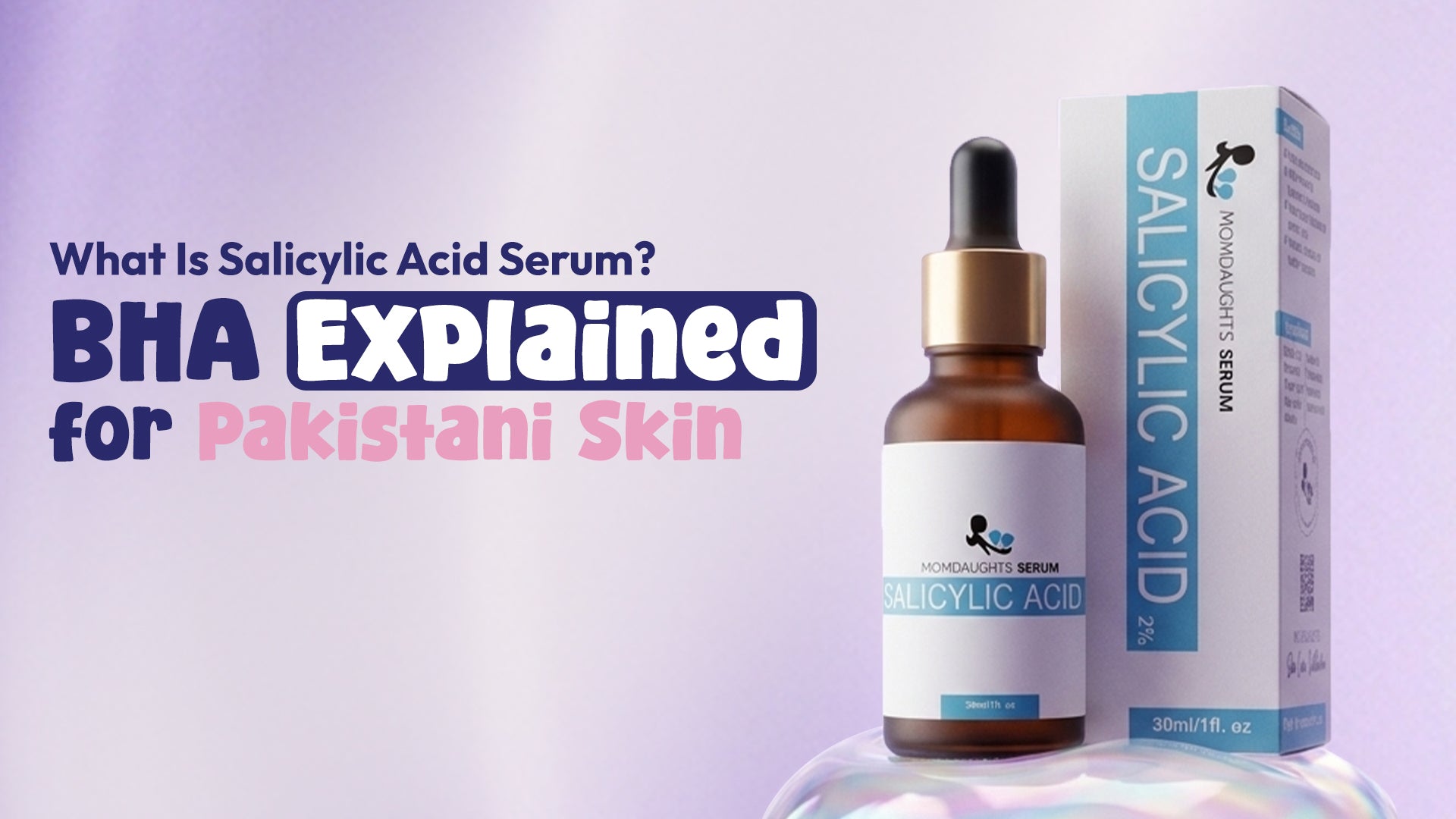
The MomDaughts Salicylic Acid Serum is a 30ml formula combining salicylic acid as the primary active with a supporting cast of skin-friendly ingredients.
Salicylic Acid clears pores, exfoliates dead skin cells, and reduces oiliness and blackheads with consistent use.
Hyaluronic Acid in the formula counteracts the drying effect that salicylic acid can cause, particularly for combination skin users who have dry cheeks alongside an oily T-zone.
Vitamin B5 (Panthenol) soothes and repairs the skin barrier, reducing the redness and sensitivity that some users experience when first introducing BHA exfoliation.
Allantoin is a skin-calming compound that promotes healing and reduces irritation, making the formula more suitable for daily use without cumulative irritation.
The complete formula is designed for both morning and evening use, though most users find evening use more practical because SPF must be applied over any exfoliant used in the morning.
Who Needs Salicylic Acid Serum
Women with persistent blackheads. Blackheads are open comedones, pores plugged with oxidised sebum and dead skin cells. They cannot be removed by washing alone. Salicylic acid dissolves the contents from inside the pore, gradually clearing and preventing new ones.
Women with consistently oily skin. Excess sebum is both the cause and the fuel for most breakouts. Salicylic acid's oil-soluble nature means it works through the sebum that other ingredients cannot penetrate, reducing its accumulation in follicles over time.
Women with enlarged-looking pores. Pores do not physically shrink, but they appear larger when stretched by accumulated sebum and dead cell debris inside. Clearing pores with salicylic acid reduces this stretching and makes pores visibly less prominent.
Women with hormonal acne. Hormonal breakouts in Pakistani women, commonly related to PCOS, menstrual cycle fluctuations, and stress, tend to concentrate around the jawline, chin, and cheeks. Salicylic acid reduces the congestion that hormonal sebum surges cause in these areas. It pairs well with Niacinamide serum which regulates sebum production and reduces post-acne marks from a different mechanism.
Women with fungal acne. Fungal acne (Malassezia folliculitis) produces small, uniform bumps typically across the forehead or chest, driven by yeast overgrowth in follicles rather than bacterial acne. Salicylic acid's exfoliation inside follicles helps control this by removing the dead cell material that Malassezia thrives on.
How to Use Salicylic Acid Serum Correctly
Patch test first. Apply a small amount to the inner forearm for 24 hours before full face use. Salicylic acid is generally well-tolerated but individual sensitivity varies.
Start every other day. For first-time BHA users, applying every other day for the first two weeks allows the skin to adjust. Daily use can begin once the skin has confirmed tolerance.
Apply on slightly damp skin. After cleansing, while the skin is still slightly damp, apply 3 to 4 drops across the face. Avoid the immediate eye area.
Follow with moisturiser. Salicylic acid can cause mild dryness, particularly in the first few weeks. Always apply moisturiser over the serum. The hyaluronic acid and panthenol in the formula provide some built-in hydration, but a moisturiser layer is still important.
SPF is essential in the morning. Chemical exfoliants including salicylic acid increase skin sensitivity to UV radiation. If using in the morning, apply SPF 30 or higher as the final step. Evening use followed by morning SPF is the most reliable approach.
Do not use with other strong exfoliants. Avoid combining salicylic acid with AHAs (glycolic acid, lactic acid) or retinol on the same evening, as cumulative irritation can result. Alternate: salicylic acid on some evenings, retinol on others.
Salicylic Acid vs Niacinamide for Acne
Both are effective for acne-prone skin but through different mechanisms. Salicylic acid exfoliates inside the pore and dissolves congestion. Niacinamide regulates sebum production, reduces inflammation, and inhibits the transfer of post-acne pigmentation. They are complementary, not competing, and can be used in the same routine at separate times.
Browse the complete serums collection for all available options by skin concern.
At MomDaughts, we believe understanding what an ingredient does is the first step to using it correctly. Confidence in every step.